Create a crvUSD credit line to Yield Basis

I support Yield Basis and believe it could be a significant positive catalyst for the Curve Ecosystem.

However, I am not comfortable approving this proposal without the following conditions being met:

  1. Third-Party Economic Risk Report
    A $60M preminted credit line is irresponsible without extensive upfront economic research. A third party should analyze the proposed wrapped assets, liquidity constraints, and backtest the protocol under black swan scenarios.

Currently, only the Yield Basis team has conducted research into the economic risks and limitations of the protocol. While there have been five or more technical audits of the code, no third parties have been consulted to recommend economic guardrails to protect CurveDAO. In its current form, this proposal creates a single point of failure for crvUSD and CurveDAO. If Yield Basis is hacked and $60M in crvUSD floods the market, CurveDAO would be unable to cover the loss. The entire ecosystem, along with most projects built on it, could collapse. The Yield Basis private credit line should be capped as a percentage of crvUSD AUM, based on an acceptable level of risk for CurveDAO. Individual assets (wBTC, cbBTC, and tBTC) should also be capped as a percentage of crvUSD AUM, based on their specific risk profiles and liquidity levels. Without proper risk analysis and guardrails, this proposal poses a massive risk to the Curve Finance ecosystem.

  1. Yield Basis Hack Recovery Plan
  • In the event of a Yield Basis hack or a drained crvUSD LP, who is responsible?

  • What is the plan to repay the debt?

  • Are any contingency plans scalable?

Based on the current proposal, Yield Basis bears no risk, leaving CurveDAO to shoulder the entire burden. In a scenario where Yield Basis’s crvUSD LPs are drained, Yield Basis could abandon Curve and pivot to another stablecoin protocol, leaving CurveDAO in ruins.

  1. Yield Basis Transparency

    This proposal should not proceed to a vote without full transparency from Yield Basis on the following:

  • Full list of seed investors and their allocations

  • Tokenomics

  • Risk vectors

  • Scaling plans

There are numerous Curve Ecosystem founders and investors with potential conflicts of interest regarding this proposal. In the future, CurveDAO should prohibit seed investors from participating in governance votes, especially when they control delegated votes. Any clear conflicts of interest should be disclosed, allowing users to withdraw their tokens from ecosystem protocols and vote independently. Additionally, there has been insufficient transparency regarding risk vectors, Yield Basis tokenomics, and scaling plans. These must be addressed before moving forward.

  1. Clear Incentive and Compensation Plans

The current $YB allocation for Curve is grouped into a single, vague incentive package.

A detailed breakdown of $YB incentives is needed to set a precedent for future engagements with partner protocols. For example, the licensing fee for cryptopools technology is currently bundled with other incentives. If it is truly a licensing fee, the $YB should be paid upfront, not provided as bribes that force Curve to pay emissions for others leveraging their technology.

In conclusion, this proposal has extremely significant long-term implications for the Curve Ecosystem, it should be taken seriously.

A $60M private credit line is not a trivial request and carries substantial risk. It is the responsibility of the Yield Basis team to demonstrate the protocol’s viability and address these glaring risks and concerns before moving forward.
1 Like

Responded on X and copying here.

Let me respond to these concerns, as it seems like the Small Cap Scientist did not read the proposal very well.

  1. We had 6 audits (and actually 7th ongoing just in case, but looks good). This is exactly because safety is the first priority. As a guard rail, emergency stop of the protocol is given to Curve Emergency DAO multisig. The system was well communicated and studied in advance.

  2. If anything happens - of course it’d be on Yield Basis to deal with it to the highest degree possible. The risk though is true for anything new launched tightly integrated with Curve, new Curve products etc, so we did actually more audits than new Curve code usually has just in case.

  3. The breakdown of the allocation is added to the proposal. But if anything - it is very natural to invite notable persons from the ecosystem as investors in such a project. If you disagree - you need to lock CRV for veCRV and vote only with those. But I think that partner projects are the strength of Curve!

  4. Paying Curve is going to be via allocation controlled by veCRV going as a stream proportional to inflation. It will be only UP TO CURVE DAO to decide how to direct it! If Curve DAO decides to not incentivize crvUSD pools but to use it in any other way - fine, but I think buying votes for crvUSD/stable pools like crvUSD/USDC is the best use here. Cryptopools related to crypto liquidity working for Yield Basis should get no CRV inflation (and there are good economic reasons why)!

4 Likes

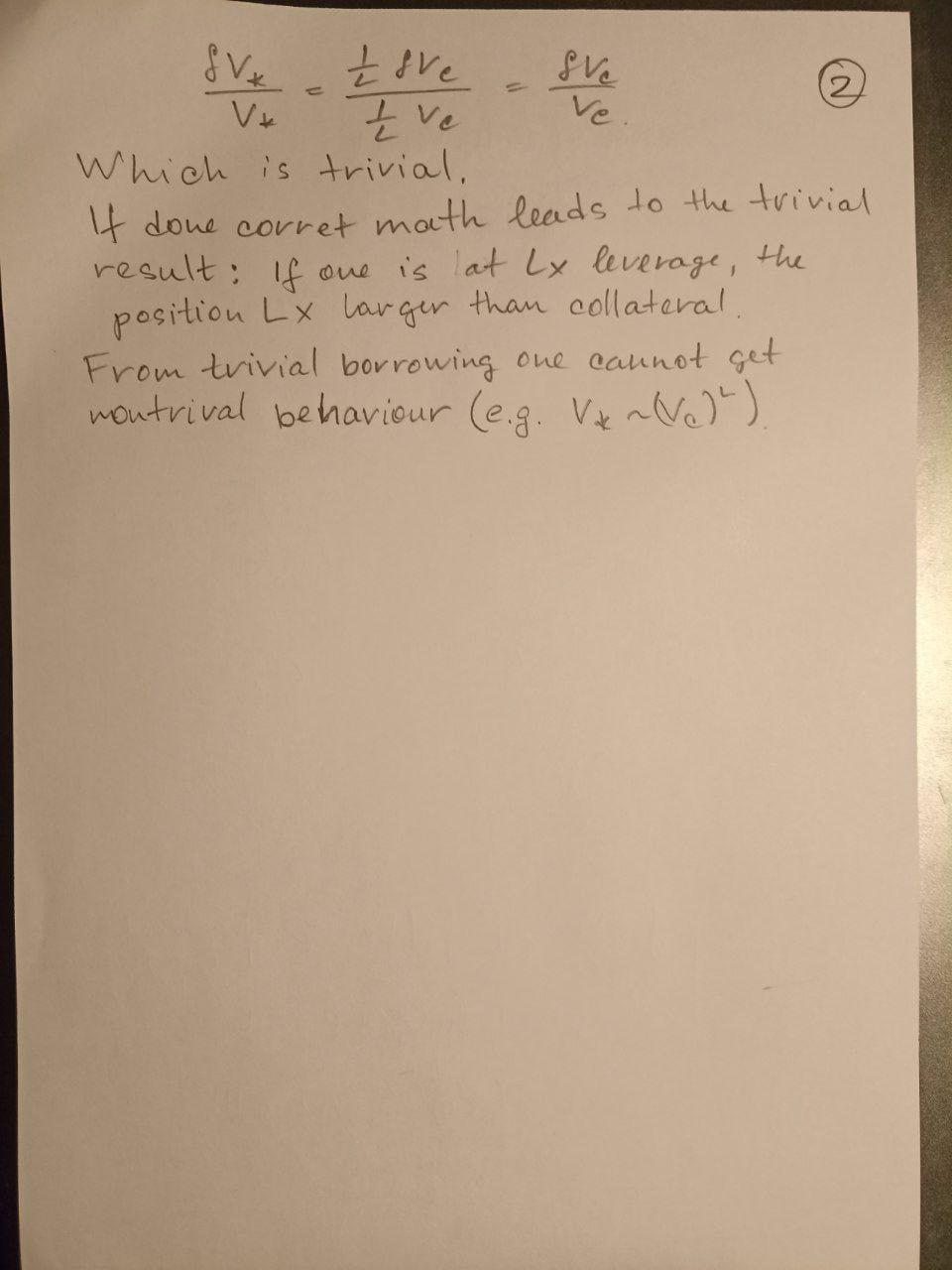
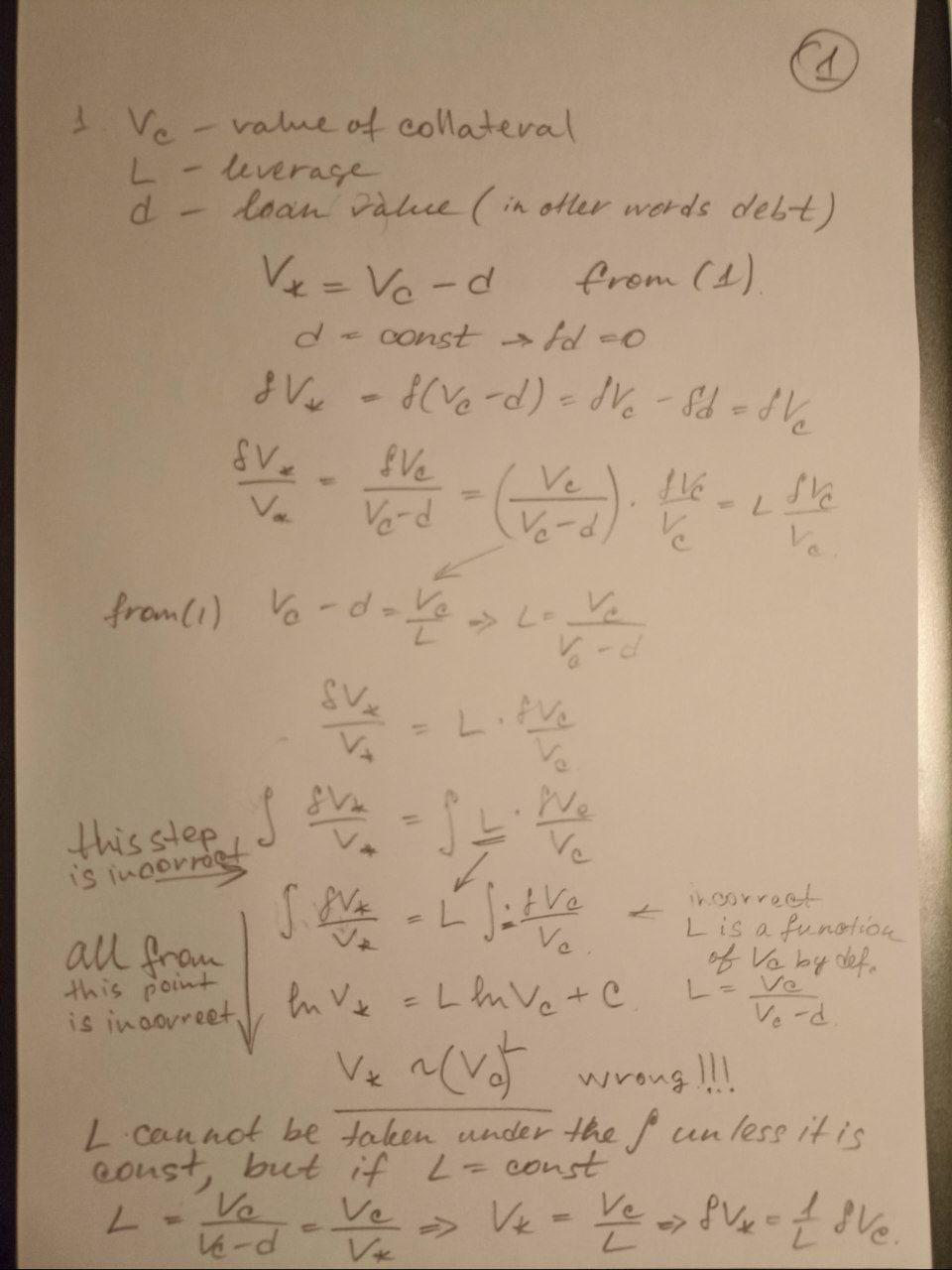
Have been working through the math in sections 2.3-2.4 of the primer and wanted to ask for clarification.

The paper defines leverage as always keeping

d=Vc​(1−1/L)

so that V*= Vc/L at all times (from the quote attached). If I differentiate that, I get the “trivial” result:

δV*/V* ​​​​= δVc/Vc​​

But in §2.3, the derivation also uses the step where debt is fixed and gets

δV*/V* ​​​​= L(δVc/Vc​​)

which is then integrated to give

V*∝(Vc)^L

From my notes (pages 1–2 attached), I see two possible interpretations:

  1. If leverage is continuously maintained as defined, then V* should just track Vc linearly.

  2. If the intent is that the “frozen-debt step” dominates and is integrated on its own, then the power-law makes sense, but that seems to require an additional assumption not spelled out.

So my question: are there further assumptions behind §2.3–2.4 that justify treating Eq. (6) as the total differential to integrate, rather than just a step-specific relation?

Appreciate any clarification — this seems like the key detail that decides whether the growth is linear in Vc or exponential in L.

1 Like

I think I need to review the paper with a fresh eye. But maybe you are right in a sense that value of leveraged position should go as square of the PRICE of LP, not as quantity of LP squared

1 Like

Thanks for the clarification. So the whole (Vc)L(V_c)^L(Vc​)L super-growth pitch doesn’t actually hold, it’s just LP price scaling, not LP quantity.

Which means the “no IL” claim isn’t really true at all, you’re still bleeding IL, only hoping fees cover the hole. That’s not eliminating IL, that’s just rebranding it as “offset when lucky.”

Am I wrong with this take?

If IL is still present, then during adverse price moves you’re not just “flat,” you can actually face drawdowns. Unless fees perfectly offset at all times (which is unrealistic), LPs are exposed to real losses. That makes the “no IL” framing misleading, since users still carry downside risk, only softened if volumes stay high.

Yes, you are wrong in this take indeed.

1 Like

Got it, but let me push back a bit.

If the math doesn’t really justify V∗∝(Vc)LV^* \propto (V_c)^LV∗∝(Vc​)L, then IL isn’t truly “eliminated,” it’s transformed. In a low-volume or low-fee environment, the rebalancing costs can exceed fee income, which means the position will draw down relative to just HODL’ing.

So my question is: in those adverse conditions, where exactly does the model protect LPs from losses? Because unless the fee stream always covers the rebalance drag, it feels like IL risk is still there, just hidden under different assumptions.

Appreciate the dialogue.

Actually math justifies, but you need to read the assumptions which are written in text. What works is:
p_{position}\propto p_{twocrypto LP}^L.
And this is exactly what eliminates IL. However, it does cost something, this cost though does not depend on the price. This cost depends on volatility (it is lower if volatility is lower, but profit is also lower when volatility is lower)

Michael above is correct in asserting that the WP contains the details on assumptions made.

  1. Regarding the proportionality: the objection to the movement of L into the integral is correct only if considered in the middle of a state transition because L is an invariant of that transition; in the paper, no exponentiation is done until eq. 10, which happens only after all three steps into which the state transition is split are considered jointly. This allows us to treat L as a constant and obtain the claim Michael made in eq. 11.
  2. The rebalancing fee drawdowns you refer to are unrelated to impermanent loss; IL is begotten purely by the sublinearity of the value function, and therefore elimination of sublinearity eliminates IL just as well. Operational costs such as rebalancing expenses are a different category, which can be seen at least by their irreversibility; should you consider a path from state A in the price space to state B and back, the IL would be zero because it is a state function, but rebalancing expenses would not be zero because they are path functions. As such, while the design doesn’t remove IL for free (to be fair, it was never claimed to be removed for free from what I’ve seen of the materials provided by the YB team), it does remove it, full stop. Hopefully, the non-equivalence between the two adverse effects has been sufficiently demonstrated.
  3. Assuredly, the presence of associated costs does present a risk insofar as it is possible to construct a theoretical scenario in which the protocol experiences a negative APR. Although backtesting shows that such a scenario is highly unlikely, the team cannot guarantee that it won’t happen. This point is valid.

Thanks for the detailed explanation. I see the distinction you’re drawing between IL as a state function and rebalancing drag as a path function.

But from a user’s perspective, the end result is the same: your equity can still go down. Whether you call that “IL” or “operational cost,” it’s still a drawdown. Saying IL is “eliminated, full stop” feels like semantics when there’s still a scenario where LPs come out behind.

Wouldn’t it be more accurate to say IL is transformed into a volatility-linked operating cost, which fees may or may not cover, rather than eliminated entirely?

If there’s always a cost tied to volatility, isn’t that just IL by another name? Calling it something else doesn’t change the fact LP equity can still draw down when fees don’t cover it.

Operational costs such as rebalancing expenses are a different category, which can be seen at least by their irreversibility; should you consider a path from state A in the price space to state B and back, the IL would be zero because it is a state function, but rebalancing expenses would not be zero because they are path functions.

There is no free lunch in finance, ofc theoretically there can be negative result due to operational costs, but in simulations that were presented - trading fees yield (much less than 10%) covers it. And it worth mentioning that 50% of fees generated by the position are used for rebalancing.

Volatile market => more rebalancing needed, but at the same time much more fees that will cover it (originating from volatility → trading volumes in the pool)

Flat market → almost no rebalancing need, almost no volatility, small fees, but also no need for rebalancing → no expenses

Once again, it is incorrect to equate IL with operational costs. Operational costs are not virtual, but they have a definitive source of funding. IL, on the other hand, has full theoretical reversibility, even in the absence of income streams.

No it isn’t.

IL is IM(!)permanent since it is a temporary loss arising from changing ratio of assets vs. portfolio outside AMM.

Rebalancing costs are permanent expenses. They are spend and no chance to recover. A specifically allocated portion (50% in case of Yield Basis) of pools’ trading fees is aimed to cover them

You have to consider Goodhearts law here. Not to judge the proposal, I don’t know…but the nature of adding this structure changes the rules of how people will play the game. The backtesting would look different.

If Curve was the sole small LP layer for these tokens, people could just grind the price volatility side to side to extract “operational costs”/IL (potentially).

I don’t have time to delve further into this (I won’t be commenting further in this thread). I’m not sure that it’s a great idea.

Kind of checks all the boxes, kind of seems sketch at the same time.

Both the concept of

  1. giving out free crvUSD loans to some parties but not other
    AND
  2. exploitability against the “operational costs”/IL due to this free crvUSD
    have to be thoroughly covered and understood.

I assume part of it is simply that holding BTC has been more profitable than delta-neutral positioning in recent months.

What do you think about both messages above? Are the team able to comment.