Cut all further or ongoing L2 developments

Summary:

What has been built can remain, but further development maybe should stop.
Abstract:

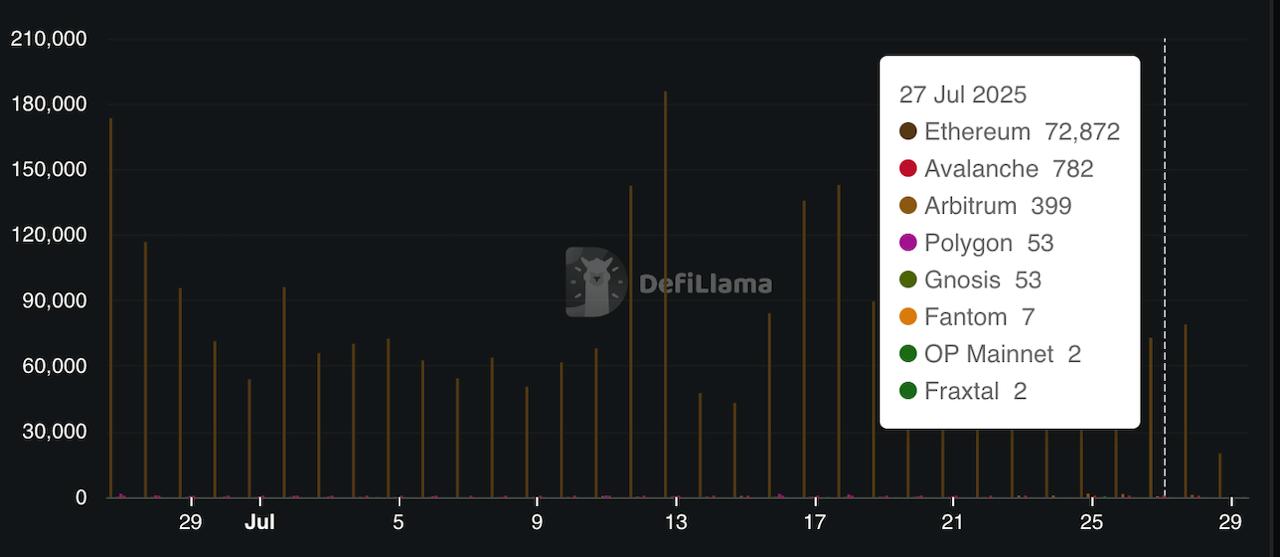
L2s eat the time of talented devs. Each of those chains require at least the same care as Ethereum, while giving back only very little. By cutting all development in this direction, Curve can regain the head-space to push into more fruitful directions.

Motivation:

Bringing Curve to L2s has been tried now, but the stats speak for themselves. Very little returns (about 1,500$ per day, all L2s combined) while consuming lots of dev time to develop, while also having mostly much higher maintenance cost due to their fast paste, short lived, nature.

Specification:

Practically this means:
What currently runs can keep running, but lets delete for all Curve Devs all L2-linked entries on their to-do-lists

For:

Builders could spend their productive time on more meaningful things

Against:

Perhaps there are bigger opportunities for Curve to be found on L2s, that haven’t been so yet.

Poll:

Cut L2 development?
  • Don’t cut L2 development
  • Reduce L2 development
  • Cut L2 development
0 voters
1 Like

Given how radical this proposal is, shouldn’t it be supported by more thorough elaboration? It’s hard to see how a meaningful discussion can begin without any background or context.

1 Like

I want to clarify that this post does not represent anything other than my own opinion, and is only intended to spark reflections. Everything that got deployed should remain.

All the 24 L2s, on which Curve is currently deployed, result in roughly total 1,500$ of daily revenue, or 62$ on average per day per L2.

Curves’ Ethereum Pools generate on a slow day 28,000$ of revenue, the equivalent of approx. 450 L2s, given their average revenue.

In my opinion, Curve should double down with Ethereum instead, focusing for example on broader scrvUSD adoption within the Ethereum ecosystem.

1 Like

I understand that the proposal aims to address Curve’s inefficiency on other L2 networks, which, in my opinion, could also be called liquidity fragmentation. To tackle this issue, I believe CrossCurve does a good job or is at least heading in the right direction.

What does the Curve team think about this? Personally, I think there should be greater collaboration between both teams to improve the utilization of these L2s, thereby enhancing fees and activity on those networks.

I personally use the Ethereum network more than other L2s, but I believe that if Curve wants to launch or deploy on L2 networks, it needs to adapt to the type of users on those networks. Generally, those using Curve on other networks are retail users with small capital, but many of them end up not using Curve because there are other protocols that are more efficient on those networks.

I think we live in a world where it’s increasingly easier to ‘export’ what Curve offers on mainnet to L2s. If Curve could enable its CDP, money market, locking, and voting to be used on the L2 networks where it’s deployed, more people would use it, and that would increase activity. The idea would be for a user to interact with an L2 and have the same experience as on Curve’s mainnet. For the user, it would feel seamless, but ultimately, everything they sign on those L2s would be bridged to mainnet.

I don’t know how difficult or costly it might be for the Curve team to develop this, but I think it would be a way to increase Curve’s usage on those L2s and Curve in general.

In the end, the question is whether to focus solely on the Ethereum network or on both Ethereum and L2s. If Curve wants to expand to even more networks than it currently operates on, it needs to improve activity one way or another. For now, it’s a no-brainer: if you want to fully leverage what Curve offers, you go to mainnet. But if Curve wants to maintain and grow its presence on other L2 networks, it needs to propose ideas to improve activity and attractiveness for those networks.
At least, that’s my opinion.

2 Likes

I tend to agree with this

My preference would be to continue Curve-lite deployments, but pause any further large tasks for L2s/chains. Curve-lite’s architecture has already been built out, and seems relatively straight forward to deploy.

The return for the DAO on L2 products has unfortunately been subpar, and it’s very hard to justify spending further resources on it. Better to spend time optimizing products and deployments for Ethereum in my opinion, that’s where our TVL, users and fee generation happens.

1 Like

It is easy to sometimes, consider only the first-order consequences. However if you look beyond the immediate short-term impacts you can see that this is a fundamentally wrong proposal for one reason and one reason alone: mind share. market share. It is in Curve’s best interests to expand to every available chain and be there FIRST, before anyone else can spin up a shitclone. Is Curve stablecoin infrastructure for ETH or is it for DEFI? By backing off based on today’s metrics you risk missing out on unknown and exponential upsides and forever being seen as the ones who got left behind as the ecosystem expands and grows along potentially unforeseen paths.